
Music
At Gladstone Primary Academy, music is a highly valued subject, it supports our pupils in building a sense of community, and they grow in confidence through shared performances and singing. It enables them to show their creativity through the compositions and sounds they make and helps us to build the cultural capital of our children.
The music curriculum is underpinned by the Charanga Scheme and delivered by a specialist teacher.
Music is taught from EYFS to Year 6 and is built around a spiral progression to ensure skills are revisited and built upon each year.
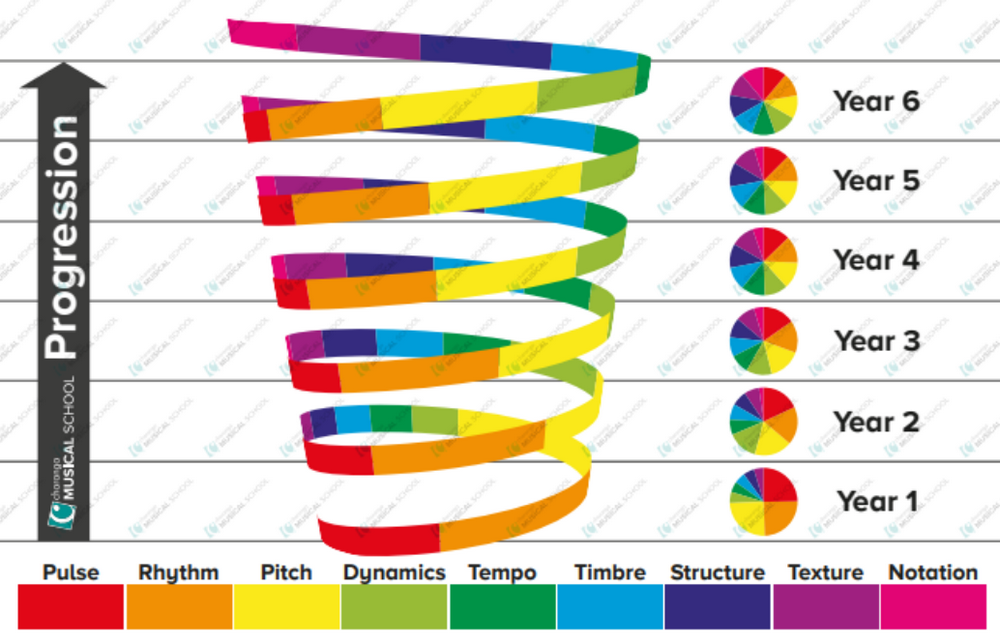
Each year group is taught a unit each half-term. Each unit is made up of 6 lessons (steps).
The units of work comprise the strands of musical learning which correspond with the National Curriculum for music:
- Listening and Appraising
- Musical Activities
- Performing
Knowledge Progression Table (Years 1-6)
|
Skill Area |
Year 1 |
Year 2 |
Year 3 |
Year 4 |
Year 5 |
Year 6 |
|
Listening & Appraising |
Know 5 songs by heart; recognise instruments; enjoy moving to music |
Know 5 songs; understand chorus/response; songs tell stories |
Know 5 songs & styles; identify sections & instruments; discuss lyrics & feelings |
Know 5 songs & styles; identify musical dimensions. |
Know 5 songs; style indicators; historical context; compare songs |
Know 5 songs; style indicators; historical context; compare songs; musical identity |
|
Games (Pulse, Rhythm, Pitch) |
Find pulse; copy rhythms; pitch copy back. |
Find pulse; copy rhythms; add high/low sounds |
Know difference between pulse & rhythm; understand how pulse, rhythm & pitch work together |
Understand pulse, rhythm, pitch and musical leadership. |
Understand pulse, rhythm, pitch, tempo, dynamics, texture; syncopation and leadership |
Understand pulse, rhythm, pitch, tempo, dynamics, texture; syncopation and leadership |
|
Singing |
Sing/rap 5 songs in unison; start/stop with leader |
Sing 5 songs in unison; warm-ups and correct singing position |
Sing in unison & simple two-parts; explore solo singing |
Sing in unison & two-parts; explore solo; awareness of tuning |
Sing in unison & backing vocals; solo & rap; strong internal pulse and sense of rhythm |
Sing in unison & backing vocals; solo & rap; represent style & context of the song |
|
Playing Instruments |
play simple rhythms; treat instruments with respect |
Play tuned parts in time with pulse; know some instrument names Introduce notation |
Play differentiated parts or melody; introduce using notation or memory |
Play any part or melody; rehearse & perform; lead playing |
Play with correct technique; use notation; lead rehearsal |
Play with correct technique; use notation; lead rehearsal; know treble stave |
|
Improvisation |
Improvise using percussion instruments, clap & improvise rhythms |
Improvise using 1–2 notes |
Bronze: 1 note; Silver: 1–2 notes; Gold: up to 3 notes |
Bronze: 1 note; Silver: 1–2 notes; Gold: up to 3 notes |
Bronze: 2 notes; Silver: 3 notes; Gold: 4 notes; know famous improvisers |
Bronze: 3 notes; Silver: 4 notes; Gold: 5 notes; know famous improvisers; style-specific improvisation |
|
Composition |
Create simple rhythms; learn notation basics |
Create simple melodies (1, 3, or 5 notes); begin to learn notation & changes |
Create melody (1–5 notes); plan & record composition |
Create melody (1–5 notes); plan & record; reflect & refine |
Create melody (up to 5 notes); explain keynote; record & reflect |
Create melody (up to 5 notes); explain keynote; record & reflect; connect sound & symbol |
|
Performance |
Perform learned song; add ideas; record & reflect feelings |
Perform for audience; add ideas; record & reflect feelings |
Perform for audience; communicate meaning; reflect on what worked |
Perform for audience; communicate meaning; reflect on feelings |
Perform for audience; communicate meaning; reflect & compare performances |
Perform for audience; communicate meaning; reflect & compare performances; discuss improvements |